

The Meta ads algorithm no longer rewards the biggest budget. It rewards the best overall experience, and Meta now counts what happens after the click as part of that experience.
Meta recently published a plain-language explainer on how its ads system decides which ad each person sees on Facebook and Instagram. It’s one of the clearest descriptions the company has shared, and it changes where advertisers should put their effort. Below we explain how the Meta ad auction works in simple terms, then share the Meta ads audit checklist we now run on every account we manage.
How the Meta ads algorithm finds the right ad
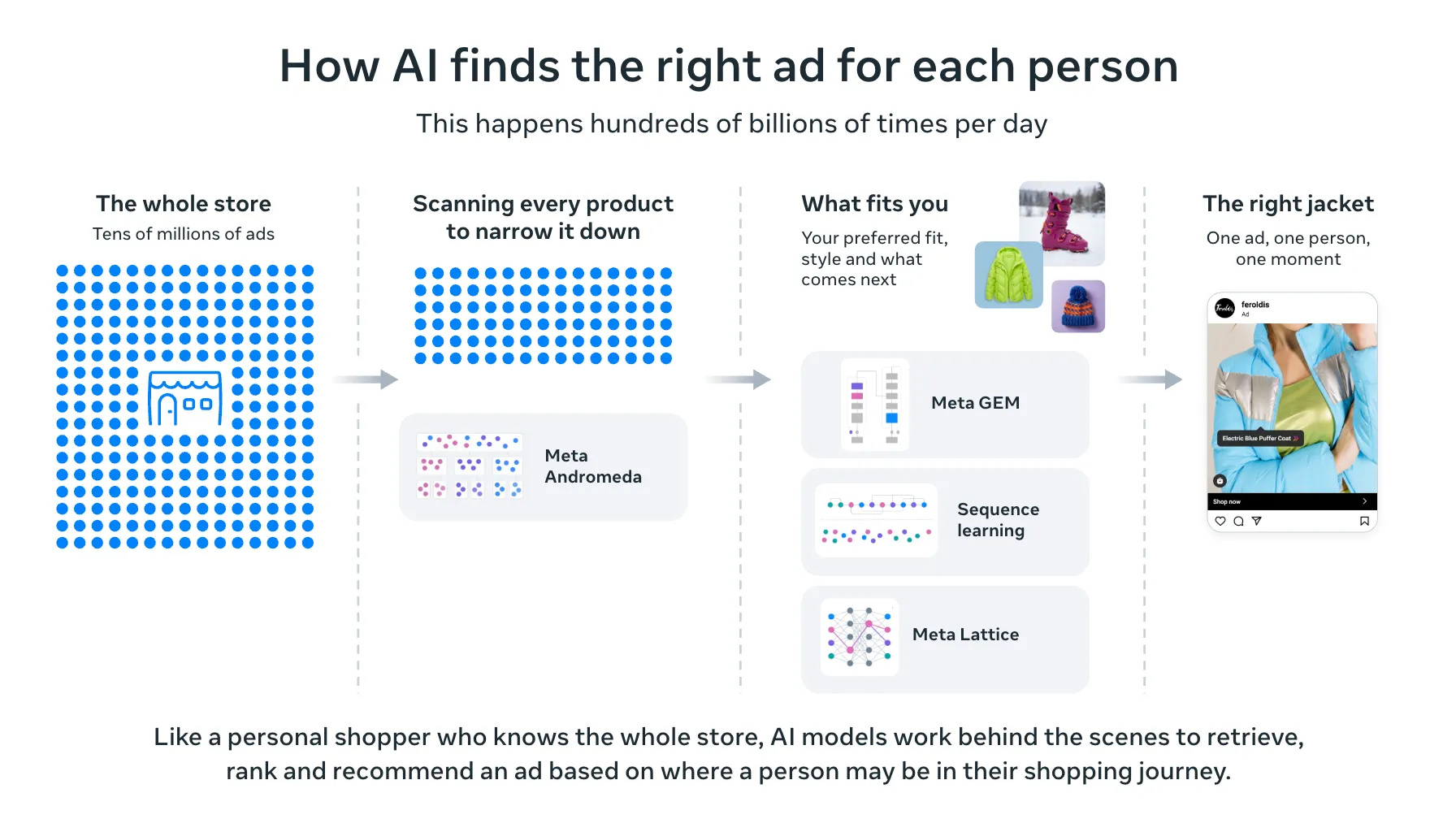
Meta uses a personal shopper analogy. We find a toy shop even simpler. Picture a shop with millions of toys and a clever helper who has a few seconds to bring you the right one.
- The shelves hold millions of toys. Every active ad across Facebook, Instagram, Threads, Messenger, WhatsApp and Audience Network is a toy on the shelf.
- The helper fills a small basket. This is Meta Andromeda, the retrieval system. It narrows tens of millions of ads down to a few thousand worth considering for one person.
- The helper knows you. Meta GEM, the largest recommendation model in Meta’s ads system, learns what each person likes. Sequence learning reads the order of what they do. If someone books a ski trip and buys boots, the useful next item is a jacket, not a second pair of boots.
- One brain ties it together. Meta Lattice is a single ranking system that learns across advertiser goals and across Meta’s apps, instead of separate models for each.
- The basket goes into a contest. The Meta ad auction picks the winner, which we cover next.
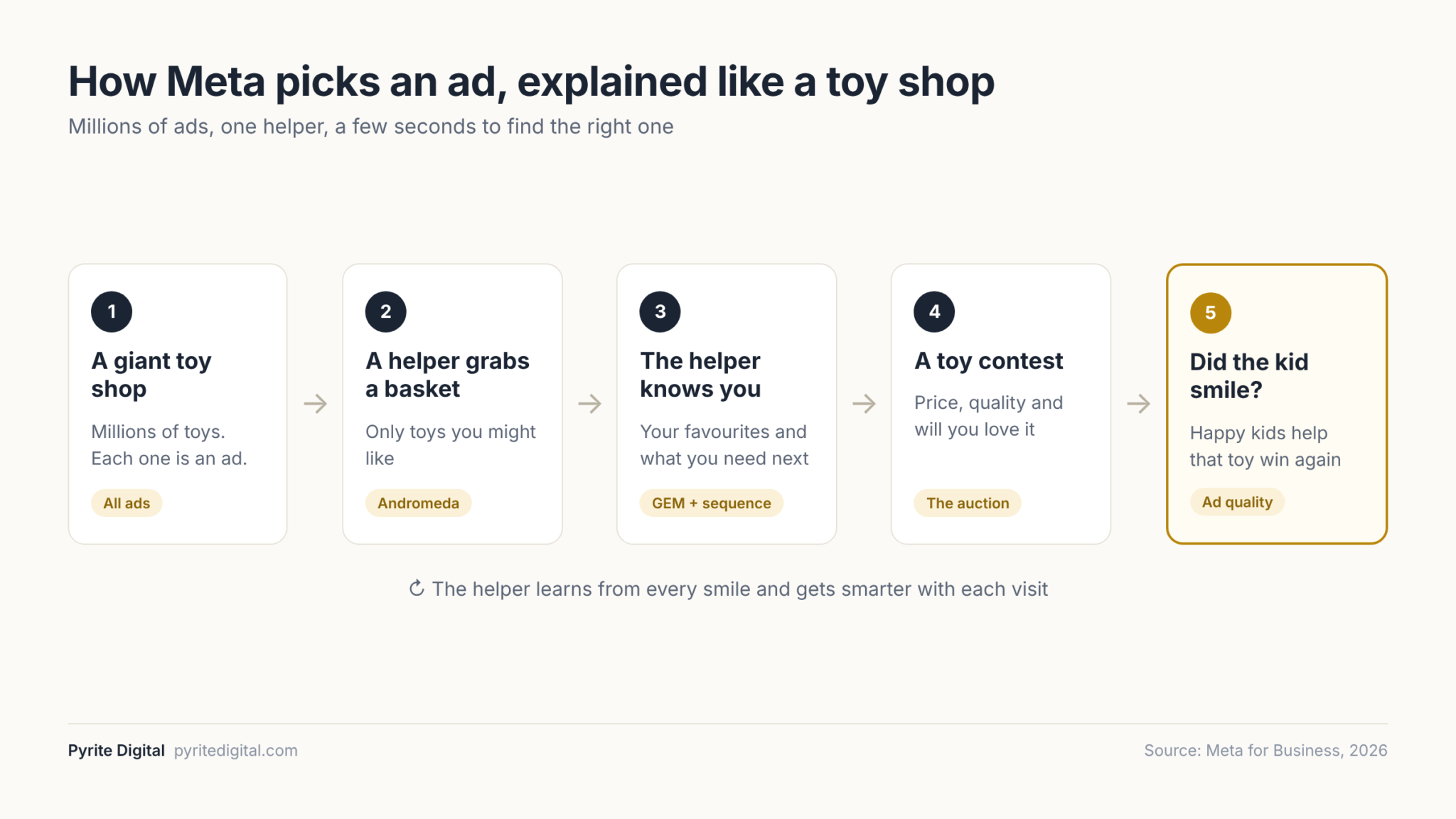
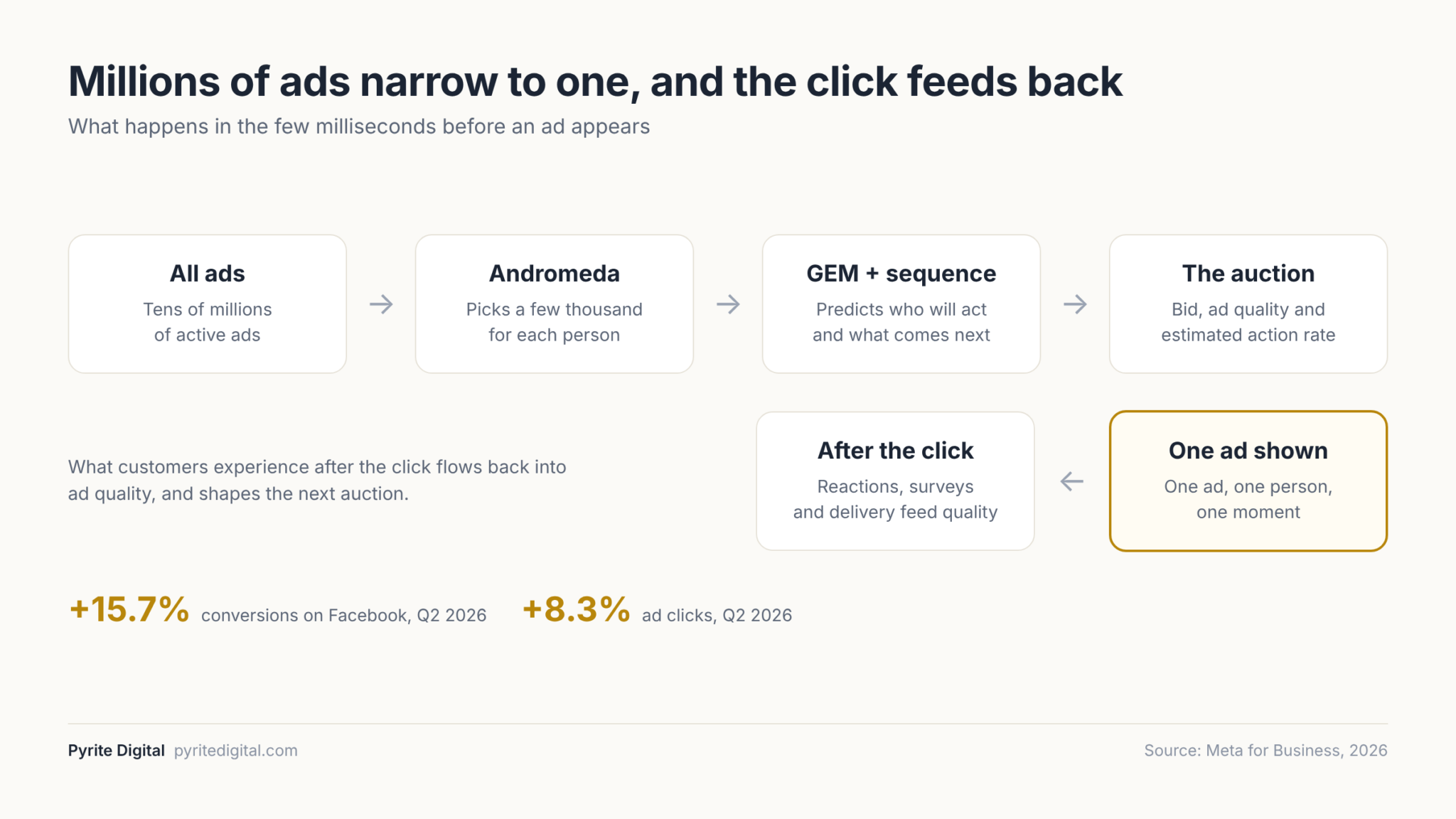
These upgrades reach every ad account automatically. Meta reports that in Q2 2026, its models delivered 8.3% more ad clicks and 15.7% more conversions on Facebook. In Q3, generative retrieval on Facebook Feed added nearly 2% more conversions in targeted segments, and Andromeda improvements added 1.4%.
How the Meta ad auction picks a winner
Every ad that makes the basket competes in a live auction, and three inputs decide who wins: your bid, ad quality and estimated action rate.
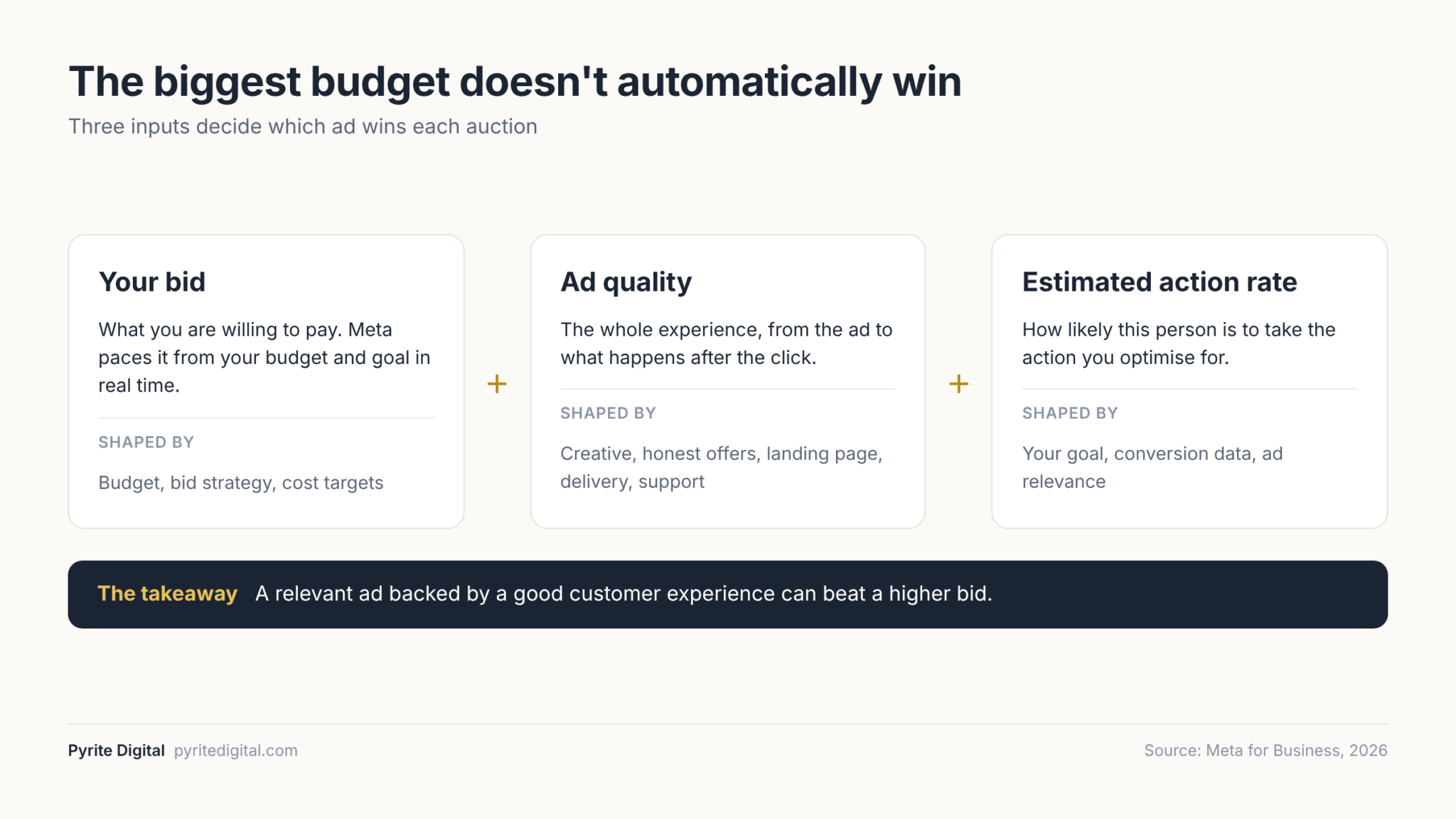
Ad quality is the input most advertisers overlook. Meta looks at how people react to ads (clicks, hides), flags low-quality traits like engagement bait or withheld information, and collects more than 200 million customer survey responses a year. Those surveys ask about purchase satisfaction, shipping delays, unexpected charges and whether people felt misled.
So a slow website, a surprise fee or a late delivery doesn’t just lose one customer. It can raise your Meta ads cost on every future impression. A relevant ad backed by a good customer experience can beat a higher bid.
What advertisers still control on Meta
The Meta ads algorithm increasingly decides who sees your ad. You still decide what the system is chasing, and that’s where results are won or lost.
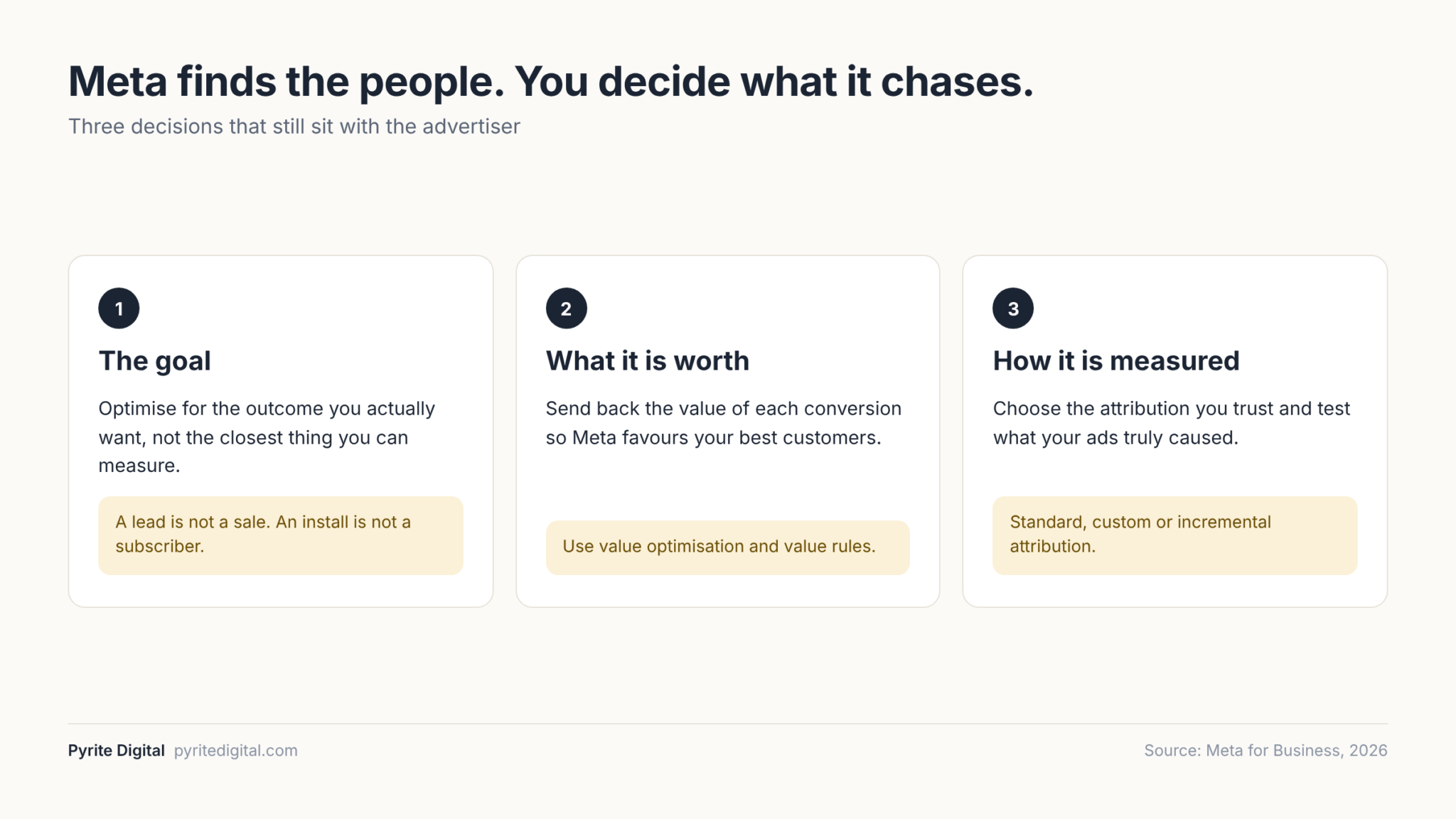
- The campaign goal. Optimise for the outcome you actually want, not the closest thing you can measure. A lead isn’t a sale, and an app install isn’t a subscriber. The system will deliver exactly what you ask for, so ask for the right thing.
- What each result is worth. Send back the value of each conversion, not just the fact that one happened. With Meta value optimization and value rules, delivery can favour bigger orders, new customers or repeat buyers over cheap one-off conversions.
- How success is measured. Choose the attribution you trust: Meta’s standard attribution, your own custom model, or incremental attribution, which counts only the conversions that wouldn’t have happened without the ad.
The less time spent fiddling with audience settings, the more time there is for these three decisions. They matter more now than any targeting tweak.
Our Meta ads audit checklist
We’ve rebuilt our Meta ads audits around how the algorithm actually works. These are the eight questions we ask in every Facebook and Instagram ad account, and the gaps we see most often.
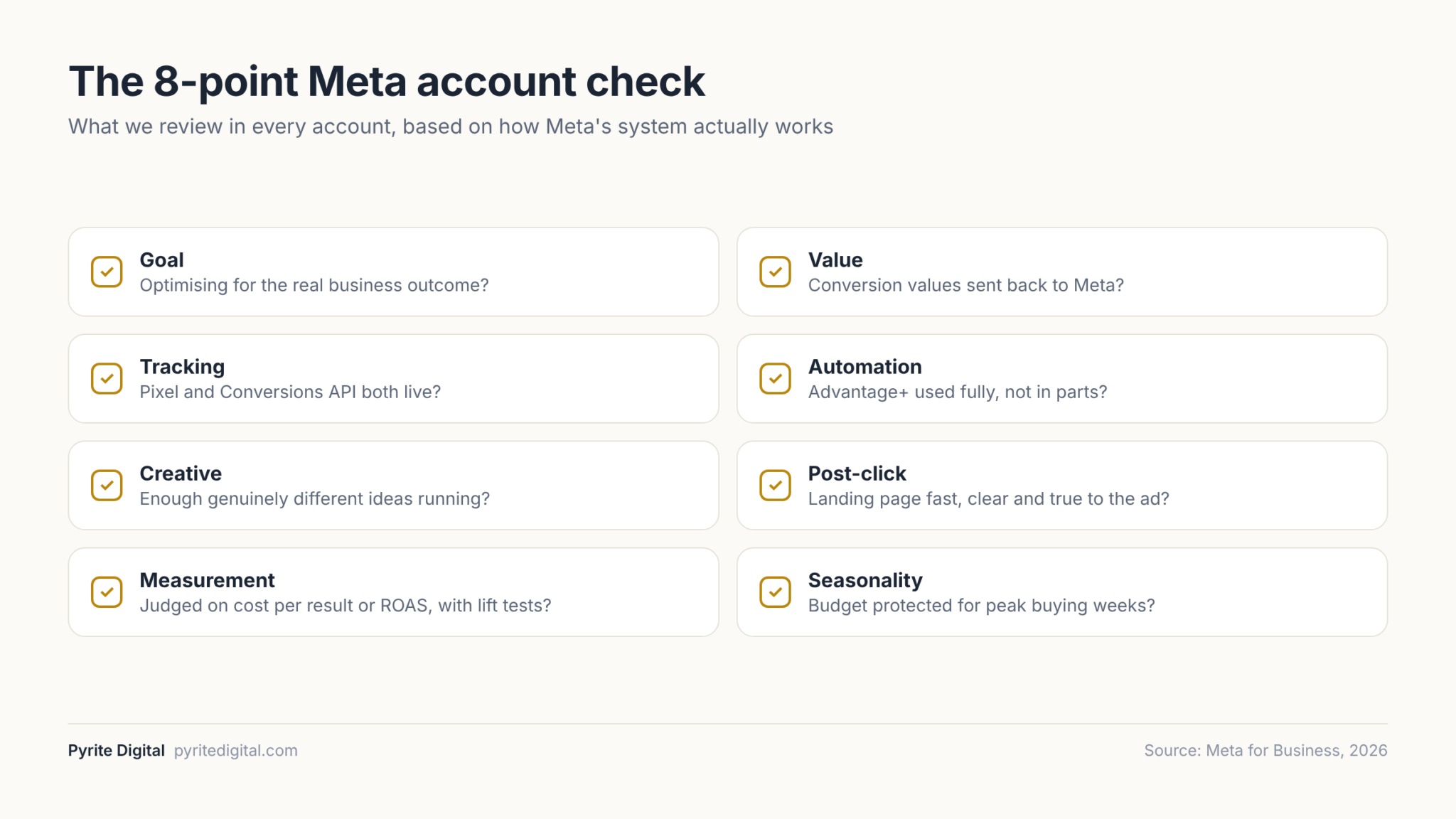
| Area | The question | Common gap |
|---|---|---|
| Goal | Is the campaign optimising for the real business outcome? | Optimising for clicks or form opens when sales are trackable |
| Value | Are conversion values sent back to Meta? | Every purchase or lead treated as equal |
| Tracking | Are the Meta Pixel and Conversions API both set up, with strong match quality? | Browser-only tracking that loses signals |
| Automation | Is Meta Advantage+ used fully, or only in parts? | Narrow interest stacks spread across many small ad sets |
| Creative | How many genuinely different ideas are running? | Ten ads that are one idea in different colours |
| Post-click | Is the landing page fast, clear and true to the ad? | Slow pages, hidden costs, an offer that doesn’t match |
| Measurement | Are results judged on cost per result or ROAS, and tested for lift? | Reach and clicks reported as success |
| Seasonality | Is budget protected for the weeks customers are most ready to buy? | Flat spend all year |
The post-click row is the newest and the easiest to ignore, because it sits outside Ads Manager. Meta’s own advice is to review shipping speed, support response, product quality and checkout friction the same way you review creative.
Frequently asked questions about the Meta ads algorithm
How does the Meta ads algorithm work in 2026?
It works in stages. Meta Andromeda narrows tens of millions of ads to a few thousand for each person. GEM and sequence learning predict who is likely to act and what they need next. Then an auction weighs your bid, ad quality and estimated action rate to pick one ad.
Does the highest bid win the Meta ad auction?
No. Meta weighs your bid together with ad quality and the predicted chance that a person will act. A lower bid with a better ad and customer experience can win.
What is Meta Andromeda?
Andromeda is Meta’s ad retrieval system. It narrows tens of millions of active ads to the few thousand worth ranking for each person, before the auction runs.
What is Meta GEM?
GEM is Meta’s largest recommendation model for ads. It learns from a huge volume of signals and shares what it learns with the smaller models that pick ads in real time.
What is estimated action rate in Meta ads?
Estimated action rate is Meta’s prediction that a specific person will take the action your campaign optimises for, such as a purchase or a lead. It’s one of the three inputs that decide the auction.
How does my website affect my Meta ads cost?
Ad quality includes what happens after the click. Slow pages, surprise charges, late deliveries and poor support can lower ad quality, which can raise the cost of every result.
Is audience targeting still important with Meta Advantage+?
Less than before. Meta now recommends adopting Advantage+ as a whole and feeding the system more creative variety, so it can find the right people itself. Location, language and legal limits still need setting correctly.
What should a Meta ads audit check?
A useful Meta ads audit checks eight areas: the campaign goal, conversion values, Pixel and Conversions API tracking, Advantage+ use, creative variety, the post-click experience, measurement and seasonal budget planning.
The takeaway
The Meta ads algorithm keeps getting better at finding the right person. Your job is to give it the right goal, honest data, a range of strong creative ideas and a customer experience worth recommending. Get those right and the machine does the rest.
If you’d like a second look at your account against this Meta ads audit checklist, the Pyrite Digital team is happy to help.
Sources
- How Meta’s Ads System Matches Your Ad to the Right Person at the Right Time, Meta for Business
- Meta Has A New Ad Ranking System Built On LLMs, Plus Upgrades To Andromeda And GEM, AdExchanger, October 28, 2026