

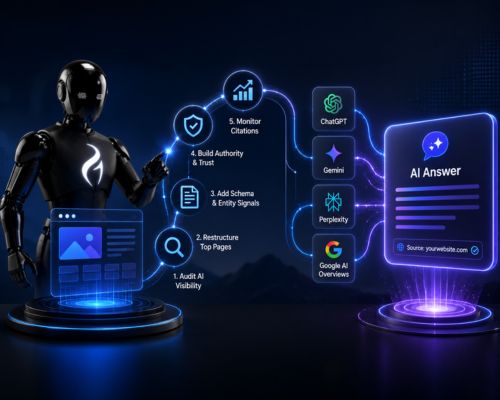
How do you do AEO in 2026? Audit your current AI visibility across ChatGPT, Perplexity and Google AI Overviews, restructure your top pages so direct answers come before explanations, add schema markup and entity signals that make your brand identifiable to AI models, then monitor citations in Google Analytics 4 and adjust monthly. It’s a repeatable loop, not a one-time project.
“How to do AEO” is a practitioner’s search, not a beginner’s one – you already know Answer Engine Optimisation (AEO) is the work of getting AI engines to quote your brand directly instead of just linking to it, the way Search Engine Optimisation (SEO) gets a page ranked in the first place. What you’re after is a process you can actually run, and that’s what this piece gives you.
AEO sits inside the same broader shift toward AI SEO and LLM SEO – search that responds to a person’s search intent with a generated answer instead of a results page. Why does AEO matter enough to build a whole strategy around? Because ChatGPT, Perplexity and Google AI Overviews are increasingly answering questions directly, often without sending a single click back to your website. If you’re not the source that answer draws from, you’re invisible at the exact moment someone was ready to buy.
A quick note on timing: a fair amount of what worked for AEO in 2025 has already shifted heading into 2026 – engines have gotten stricter about schema quality and faster at re-crawling, which is part of why this framework leans on a monthly monitoring loop rather than a one-time setup. If you need the fundamentals first, our glossary piece on what AEO actually means is the better starting point; this one assumes you’re ready to build.
The AEO Framework: Audit → Structure → Schema & Entity → Monitor
Four steps, run in order the first time. After that, Monitor feeds back into Audit, and the whole thing becomes a loop rather than a project with an end date.
1. Audit Your Current AEO Visibility
How do you audit your AEO visibility? Test the real questions your customers would ask – not your brand name, the problem you solve – across ChatGPT, Perplexity, Gemini and Copilot, and note whether you’re cited, ignored, or beaten by a competitor. Pair that with Google Search Console, checking AI Overviews impressions where the data is available, and run a technical health pass covering website performance and user experience – page speed, mobile rendering, crawl access – alongside content quality.
This step exists because most businesses skip straight to “add schema” without knowing whether they’re invisible for one query or fifty. An audit tells you where the real gap is before you spend a rupee fixing the wrong thing.
Take a business selling industrial packaging equipment – a reasonable stand-in for the “aeo strategy for industrial” searches behind this framework. Their spec sheets rank fine on Google’s page one, but an audit shows zero AI citations, because every technical spec lives inside a PDF and a product image, not crawlable text an AI model can read and quote.
In the audits we run at Pyrite Digital, this is the single most common finding: content that ranks perfectly well in Google but was never built in a format an AI engine could extract from. The ranking problem and the citation problem turn out to be two different diagnoses.
Key takeaway: audit first, fix second. You can’t tell whether you need better content or better structure until you know which one is actually missing.
2. Structure Your Content for Direct Answers
How do you structure AEO content? Put the direct answer in the first one to three sentences of each section, then explain – the reverse of how most business content is written, which tends to build context first and reveal the point last.
This applies to aeo content generally, but it’s easiest to see on a product or FAQ page. An ecommerce brand restructuring for AEO – the “aeo for ecommerce” case – doesn’t need to rewrite everything; it needs its existing product FAQs re-ordered so “Is this true wireless or Bluetooth-only?” is answered in the first sentence, with specs and comparisons following.
The evidence for this pattern isn’t new – it’s the same logic that’s driven Google’s featured snippets for years: the page answering a query in the first 40-60 words of a section wins the snippet almost every time. AI retrieval systems are doing something similar, just casting a wider net across more sources. This is also where AEO content work overlaps with ordinary content marketing – a well-structured answer reads better for a human skimmer and an AI model at the same time.
Key takeaway: write for the skimmer and the AI model at once. Front-load the answer, and let the explanation follow.
3. Add Schema Markup & Entity Signals
What schema and entity signals does AEO need? FAQPage, HowTo and Article schema at minimum, plus Organization and Person markup that identifies your brand and named authors as real, credible sources – the structured-data and entity-SEO layer that turns E-E-A-T from a Google guideline into something a machine can actually read.
This is where AEO leans hardest on technical SEO. Schema doesn’t replace good content, but a well-written answer sitting behind missing or broken schema markup is functionally invisible to the systems you’re trying to reach.
A B2B software company with no named authors on its blog for years is a common example – adding real bylines with credentials, alongside Organization and Person schema, tends to show up fastest in Perplexity’s cited sources, since that engine leans heavily on visible authorship when deciding what to quote.
Key takeaway: entity SEO is E-E-A-T made explicit for machines. Say clearly who you are, and mark it up everywhere an AI model might look.
4. Monitor Citations and Iterate
How do you monitor AEO results? Track AI referral sessions in Google Analytics 4 (GA4) by watching for traffic from chat.openai.com, perplexity.ai and similar domains, re-run your baseline prompts from Step 1 monthly, and keep an eye on Google Search Console’s AI Overviews reporting as it matures.
Getting better AEO results over time is really about treating this step as a loop, not a report you file once. A citation you earn this month can disappear next month if a competitor restructures their content first – AI engines re-rank sources continuously, closer to real-time than a typical Google algorithm update.
Key takeaway: AEO doesn’t end at publish. Audit, structure, mark up, monitor – then go again.
AEO Checklist: Key Steps for Implementation
Copy this into a spreadsheet and work through it in order – it’s built to answer “how to rank on Google with AEO,” “how to rank in AEO,” and “how to optimise for AEO” as one connected process rather than three separate questions.
- Test 15-20 real customer questions across ChatGPT, Perplexity, Gemini and Copilot, and log who gets cited
- Check Google Search Console for AI Overviews impressions where available
- Run a technical audit of page speed, mobile experience and crawl access (website performance and user experience)
- Confirm robots.txt allows GPTBot, PerplexityBot, ClaudeBot and Google-Extended
- Rewrite your top pages so the direct answer sits in the first 1-3 sentences of each section
- Add FAQPage, HowTo and Article schema to pages that already have the matching content
- Add Organization and Person schema, with named, credentialed authors on every post
- Run a content compliance and audit check – confirm schema matches what’s actually on the page, not what you intend to add later
- Earn a handful of third-party mentions on sites AI engines already trust, rather than buying low-quality links
- Set up GA4 referral tracking for AI platform domains
- Re-test your baseline prompts monthly and log any change in citation status
- Refresh your top 10 pages for accuracy every quarter, and keep ‘last updated’ dates honest
AEO Best Practices vs Common Mistakes
| Best Practice | Common Mistake |
| Answering the question in the first 1-3 sentences of a section | Building context for three paragraphs before the point |
| Using named authors with real, verifiable credentials | Publishing under a generic “Admin” or brand-only byline |
| Adding schema that reflects content already live on the page | Adding FAQ or HowTo schema for content that doesn’t exist yet |
| Treating AEO as a monthly monitoring loop | Running one audit, applying fixes, and never checking again |
| Keeping technical content in crawlable text | Burying specs and answers inside PDFs or product images |
| Earning citations through genuinely useful content and real link building | Buying low-quality guest posts purely for a backlink |
Does AEO Strategy Differ for B2B, Ecommerce or a Website Launch?
The four-step framework above stays the same regardless of business type. What changes is where you’ll find the biggest gap first, and that’s worth knowing before you spend a strategy consulting budget figuring it out the hard way.
B2B and Industrial AEO Strategy
B2B and industrial buyers research heavily before ever contacting sales, often across several people and several weeks. AEO strategy for B2B usually finds its biggest gap in Step 3 – technical spec sheets, case studies and comparison content that exist but were never structured or marked up for AI extraction. Named author credentials matter more here too, since B2B buyers (and the AI models summarising for them) weigh expertise signals heavily.
Ecommerce AEO Strategy
AEO for ecommerce usually surfaces its biggest gap in Step 2 – product and FAQ content that’s accurate but poorly ordered for direct answers. It’s also worth pairing AEO work with conversion rate optimisation here: getting cited by an AI engine only helps if the visitor who does click through actually converts once they land.
New Website Launch AEO Strategy
AEO for a new website is really about not repeating the audit-and-fix cycle later. Build schema, author bios and direct-answer structure in from day one rather than retrofitting it after launch. If the business is locally focused, this is also the moment to fold in local SEO basics – Google Business Profile, location schema – since AI engines lean on the same local signals Google Search does.
Frequently Asked Questions
Run the four-step framework above: audit your current AI visibility across ChatGPT, Perplexity and Google AI Overviews, restructure your top content so direct answers come first, add schema markup and entity signals, then monitor citations monthly in Google Analytics 4 and Search Console. It’s a repeatable process, not a single fix.
At minimum: prompt-testing your core questions across major AI engines, a technical crawl-access check, direct-answer restructuring on your top pages, FAQPage/HowTo/Article schema, named author bylines, and a monthly re-test of your baseline prompts. The full copy-paste version is in the checklist section above.
Answer the question early in each section, use real named authors with credentials, only add schema for content that genuinely exists on the page, and treat AEO as an ongoing monitoring loop rather than a one-time project. The most common mistake is the opposite of each of these – see the best-practices-vs-mistakes table above.
The core framework doesn’t change, but B2B AEO strategy typically finds its biggest gap in schema and entity signals – technical spec sheets and case studies that exist but were never structured for AI extraction, and author credentials that matter more to B2B buyers doing multi-week research.
Most of this framework – auditing, restructuring content, building author credibility, monitoring – is a content and marketing effort you can run in-house. Schema markup and technical fixes usually need at least light developer support. Strategy consulting earns its cost when you want the framework applied faster, or across more pages than an in-house team has time for.
This framework works whether you run it in-house or hand it off – the steps don’t change, only who’s doing them. If you’d rather have Pyrite Digital run the audit and build the framework out for you, our AEO Audit and Implementation services cover exactly this process end to end. Get in touch for a free AEO audit or book a strategy call, and we’ll show you exactly where your biggest gap is before recommending anything.