

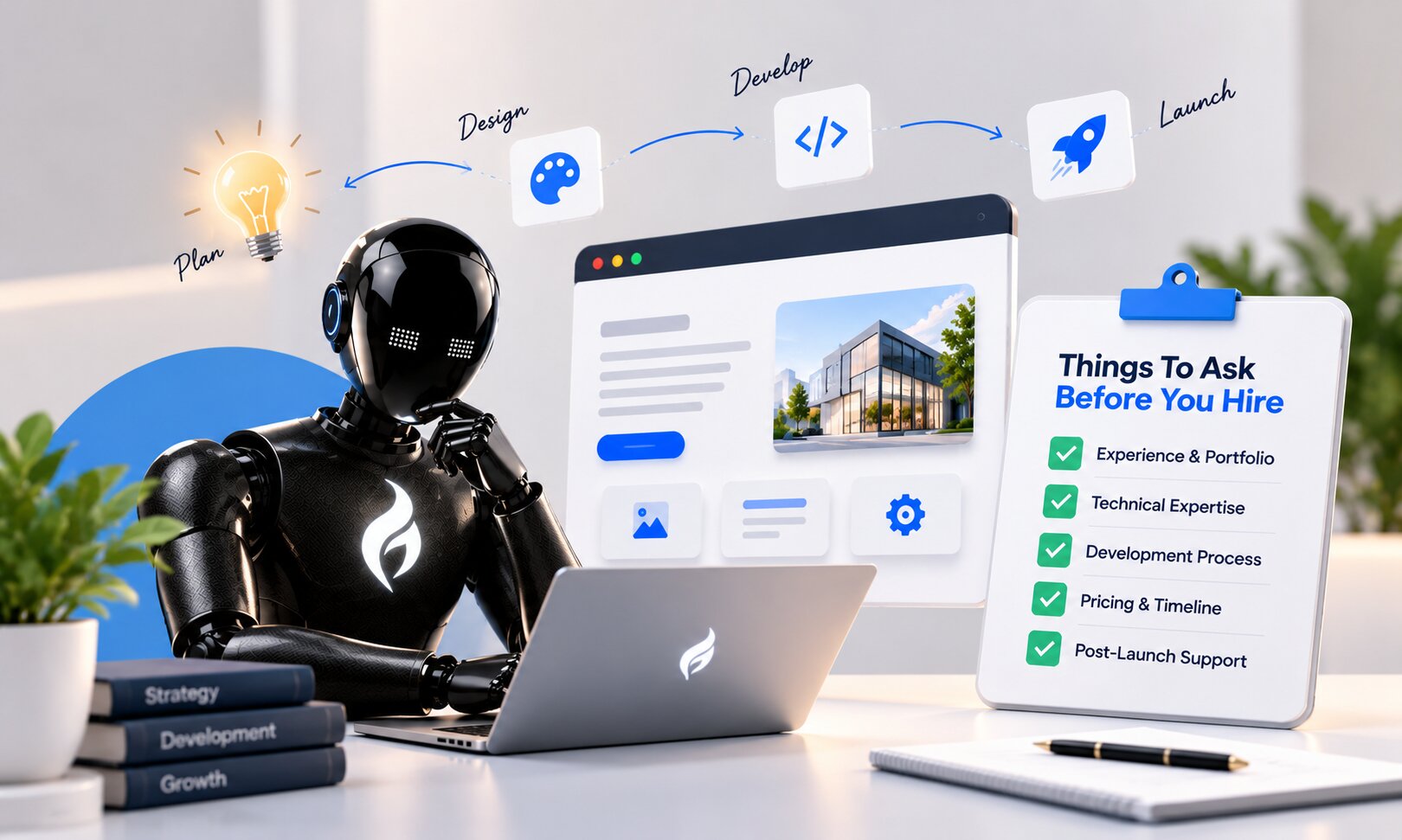
Picking a website development agency in India is easy to get wrong, mostly because the pitches sound identical. Every agency promises experienced developers, SEO-friendly code and on-time delivery. None of that tells you who will actually build your site, or what happens in week seven when the design needs changing.
The quickest way past the sales language is to ask better questions. Here are ten we’d put to any website development company before signing. Each comes with what a good answer sounds like and what should make you walk away. They work for a simple brochure site, a Shopify store or a custom portal.
What Should You Look For In A Website Development Agency In India?
Look for an agency that can show live results in your sector, builds with its own team, recommends a platform based on your goals, and plans SEO and speed into the build instead of adding them later. Price and portfolio visuals matter far less than those four things.
India has thousands of web development firms, from solo freelancers to large studios serving clients abroad. That range is useful, but quality varies enormously. A site that looks polished in a portfolio screenshot can take six seconds to load on a mid-range Android phone, which is how most Indian users browse. So treat the ten questions below as a way of collecting evidence, not a formality.

10 Questions To Ask Before You Hire A Website Development Company
1. Can you show live websites in my industry, and what did they achieve?
Ask for live URLs, not mockups, and ask what changed after launch: traffic, enquiries or revenue. Open two or three of the sites yourself and run them through Google PageSpeed Insights. Be wary of claims like ‘sales up 300%’ with no baseline or timeframe. Pyrite has built 200+ websites over 14+ years, and we’d rather walk you through live projects than a slide deck.
2. Who will actually build my website?
Some agencies win the work with a senior team, then hand the build to subcontractors. Ask who your designer, developer and project manager will be, and whether they’re employees. An in-house team usually means faster fixes and clearer accountability. At Pyrite, everyone on your project is an employee.
3. Which platform will you recommend, and why?
The right platform depends on what the site has to do. Shopify suits most D2C stores, WooCommerce on WordPress suits content-heavy shops, Webflow suits design-led B2B sites, and a custom build suits portals and unusual logic. Be wary of any firm that pushes one platform for every brief. If you need something bespoke, ask about custom website development services and who maintains the code. Selling in India? Check UPI, Razorpay or PayU, GST invoicing and cash on delivery.
4. How will you build SEO into the site from the first wireframe?
SEO is cheaper to plan before the build than to fix after. Ask how the agency handles site architecture, URL structure, schema markup, redirects and page speed, and whether an SEO specialist joins at wireframe stage. For a rebuild, expect a redirect map and Google Search Console checks after launch. ‘We install an SEO plugin” is a weak answer. Clear structure also helps Google AI Overviews and ChatGPT understand your pages.
5. What does your process look like, and what do I sign off at each stage?
You should be able to name every stage, from discovery and wireframes to testing and launch, and know what you approve of at each one. A reliable website design and development company will also tell you what it needs from you, since late feedback is the most common cause of delays. Ask how many revision rounds are included.
6. How long will it take, and what happens if the deadline slips?
Realistic timelines run about 4 to 6 weeks for a brochure site, 8 to 12 for ecommerce and 12 to 20 for enterprise projects. Get milestone dates in writing, along with what happens if either side misses them. A two-week promise for a custom store means something is being skipped.
7. What will I pay in total, and what isn’t included?
Ask for an itemised INR quote with GST shown separately. Check whether plugins, premium themes, hosting, content and training are included, and whether payments are tied to milestones. A quote far below the rest usually leaves out work you’ll pay for later. Pyrite works on rolling monthly terms with no long-term contracts.
8. How will you handle speed, mobile performance and security?
Most Indian visitors browse on phones, often on patchy 4G. Google treats a Largest Contentful Paint under 2.5 seconds as good, so ask which Core Web Vitals targets the agency commits to. On security, ask about SSL, backups, plugin updates and how personal data is handled under India’s Digital Personal Data Protection Act, 2023.
9. Who owns the code, content, designs and admin access?
Get it in the contract: you own the domain, hosting account, source code, design files and content, with full admin access at handover. Agencies that hold these themselves make leaving painful. Ask for CMS training too, so your team can edit pages without raising a ticket.
10. What happens after launch, and how will you report results?
Ask about the bug-fix warranty, support response times and who your contact is. Then ask whether reporting connects to leads and revenue, not just page views, and whether GA4 and Google Search Console are set up at launch. Pyrite monitors every site for 30 days after go-live and briefs your team on the CMS; optional retainers cover ongoing development, SEO and CRO.
Quick Scorecard: Strong Vs Weak Answers
Question | Strong answer | Weak answer |
1. Live proof | Live URLs with results, baseline and timeframe | Screenshots and round-number claims |
2. Who builds it | Named in-house team you can speak to | Vague about subcontractors |
3. Platform | Recommendation tied to your goals, with trade-offs | Same platform for every client |
4. SEO | Architecture, schema, redirects planned at wireframe | ‘We install a plugin’ |
5. Process | Staged sign-offs and defined revision rounds | Jump straight to design |
6. Timeline | Milestone dates in writing | Unrealistic promises, no penalties |
7. Cost | Itemised INR quote, GST separate, milestone payments | One lump sum, heavy upfront payment |
8. Speed and security | Named targets, Core Web Vitals, DPDP awareness | ‘Our sites are fast’ |
9. Ownership | You own domain, code, content, admin | Agency holds hosting and files |
10. After launch | Warranty, support terms, outcome-based reporting | Handover and silence |
Red Flags That Should End The Conversation
- They guarantee a number one ranking on Google. Nobody can.
- The quote is far below every other agency and the scope is vague.
- They won’t share live client sites or let you speak to a past client.
- The agency keeps the domain, hosting or admin login in its own name.
- There is no written contract, scope document or milestone plan.
- They pressure you to pay most of the fee before any work is shown.
Making The Final Call
Shortlist two or three agencies, put the same ten questions to each, and score the answers. The one that answers plainly, shows live evidence and is willing to put things in writing is usually the safest bet.
If you’d like to see how Pyrite answers them, book a free 30-minute strategy call and we’ll go through your project, platform options and timeline. You can also look through our website design services first to see what we build and how we work.